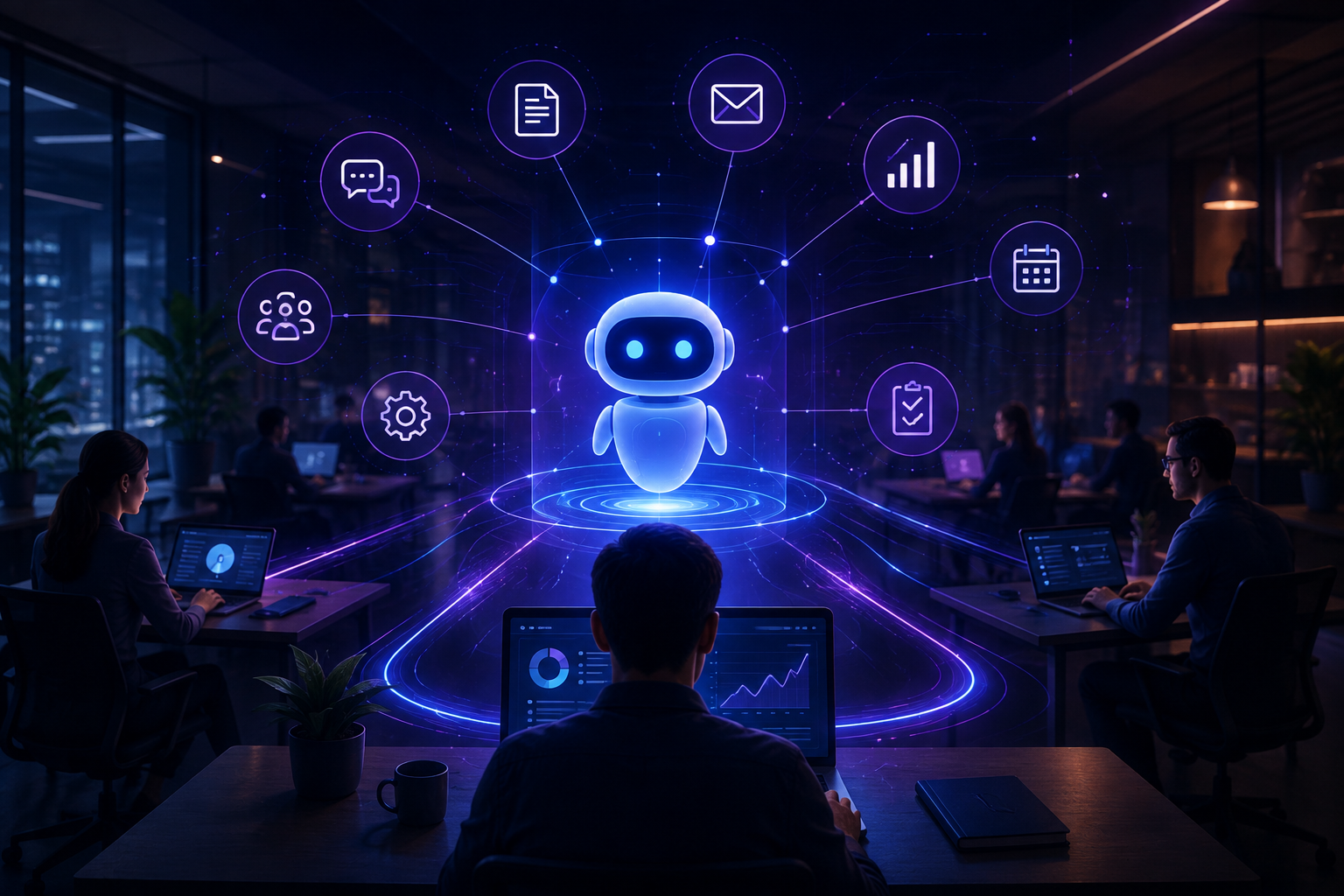
AI is no longer limited to answering questions. Today, AI agents can become active digital assistants that help organizations automate repetitive work, support employees, and keep everyday operations moving.
Turning AI Into a Digital Workforce
Every organization has repetitive tasks that consume valuable employee time—answering common questions, finding information, processing requests, organizing data, and following routine workflows.
AI agents can take on many of these activities and operate alongside human teams.
Instead of replacing people, the goal is to give employees intelligent assistance that helps them work faster and focus on higher-value responsibilities.
Where AI Agents Can Improve Productivity
1. Automate Repetitive Tasks
Employees shouldn't have to spend hours performing the same routine actions every day.
AI agents can help automate repetitive interactions and processes, allowing teams to spend more time on work that requires creativity, judgment, and human communication.
For example, an AI agent can assist with:
Frequently asked internal questions
Customer enquiries
Information retrieval
Basic request handling
Workflow assistance
Routine communication
2. Make Business Knowledge Easier to Access
Important information is often spread across documents, websites, FAQs, internal resources, and different systems.
Finding the right information can take time.
With an AI agent trained around an organization's knowledge, employees can interact with that information conversationally.
Instead of asking:
"Where is that document?"
they can ask:
"What is our process for handling this type of customer request?"
The agent can then provide an answer based on the knowledge made available to it.
3. Support Employees Around the Clock
Productivity doesn't always stop when the working day ends.
AI agents can provide continuous assistance for common questions and information requests, helping employees and customers get support without always waiting for a human representative.
This can be particularly useful for organizations operating across different locations, teams, or time zones.
4. Reduce Support Team Workloads
Customer and internal support teams often spend a large portion of their time handling straightforward questions.
AI agents can handle many common interactions first, allowing human teams to concentrate on more complex situations.
This creates a practical combination:
AI handles repetitive interactions.
People handle situations that require human judgment.
5. Create Specialized AI Agents
Not every department needs the same type of assistant.
Organizations can create specialized AI agents for different purposes, such as:
Customer support
Sales assistance
Employee support
Product information
Knowledge management
Operations
Business enquiries
Each agent can be configured around the information, instructions, and responsibilities relevant to its particular role.
AI Agents and Human Teams
The most valuable AI strategy isn't necessarily about replacing an entire team with automation.
It's about augmenting the people already doing the work.
An employee supported by an AI agent can potentially find information faster, respond to routine requests sooner, and spend more time solving problems that genuinely require human expertise.
This creates a more efficient workflow where humans remain in control while AI handles appropriate repetitive tasks.
Build AI Agents Around Your Organization
This is where platforms such as Orbitautobots can become useful.
Instead of using a generic AI assistant, businesses can create AI autobots around their own knowledge, instructions, personality, and business requirements.
You can build, train, and deploy AI-powered assistants designed for specific organizational needs.
The objective isn't simply to add AI to your business.
It's to make AI a practical part of how your organization works.
The Productivity Opportunity
AI agents can help organizations move from:
Manual → Assisted
Repetitive → Automated
Information searching → Intelligent assistance
Delayed responses → Faster interactions
When implemented thoughtfully, AI becomes more than a technology feature. It becomes another productivity layer across the organization.
Build Your AI Workforce
The future of organizational productivity will not be about humans versus AI.
It will be about people working with intelligent systems that help them accomplish more.